Text to Video API in 2026: Clips, Templates, or Videos
Every text to video API falls into one of three kinds: raw model APIs that return clips, template renderers, and pipeline APIs that return finished videos.
By Hayden · Cofounder, Framesail
Every text to video API on the market falls into one of three categories, and picking the wrong one means building the missing layer yourself. Raw model APIs return short clips from a prompt. Template APIs render structured data into an assembled video. Pipeline APIs return a finished, multi-minute video from a brief. They all say "video API" on the tin; they hand you completely different amounts of unfinished work.
Here's what each actually returns, and what's left for you to build.
Raw model APIs: prompts in, clips out
This is what most people find first: the Gemini API's Veo endpoints, MiniMax's text-to-video API, and aggregators like Replicate or fal that front Kling, Seedance, WAN, and the rest of the frontier. You send a prompt, you get back a clip, typically seconds long.
The clips are the best they've ever been. The catch is arithmetic: a 10-minute video is roughly 75 eight-second clips, and nothing about the raw API keeps clip 40 consistent with clip 3. Same character? Same environment? Same grade? That's your problem, per request.
Raw model APIs are the right choice when clips are the product: an effects shot, a hero animation, a short loop. They're the wrong place to start if the deliverable is a video someone watches end to end.
Template APIs: JSON in, assembly out
Creatomate, Shotstack, and json2video take structured input (a JSON timeline of assets, text layers, and timings) and render it into a video. Compositing is the core job: you supply most of the footage and images and the API assembles them at scale. All three now bolt generated extras onto the template (text-to-speech voiceovers, AI-image integrations), but those plug into the same fixed timeline. It's mail-merge for video, and for the jobs it fits (personalized outreach clips, data-driven social posts, thousands of variants of one layout) it fits well.
The ceiling is the template. Output quality equals asset quality, and every video is the same video with different values plugged in. If the goal is content that doesn't look generated from a template, this category can't help by design.
Pipeline text to video APIs: a brief in, a finished video out
The third category runs the production process, not just a model. One call starts a project; the script to video AI pipeline writes the script, locks character and environment references, renders a timed voiceover, storyboards every shot against those references, generates and animates the frames, and cuts the result into a watermark-free video.
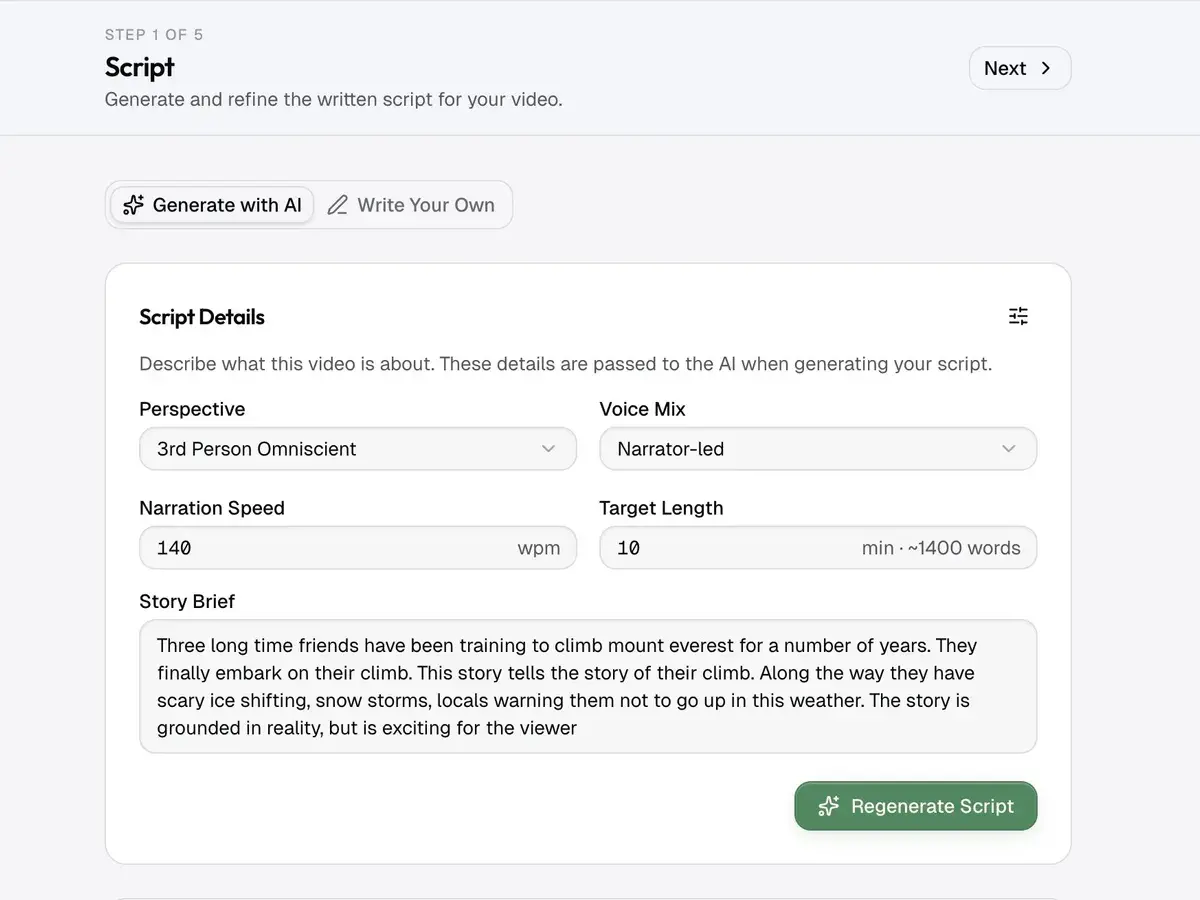
This is the category framesail's video generation API is in. The models underneath are the same frontier stack you'd hit raw (Veo 3.1, Kling v3, or Seedance 2 Pro for video, Nano Banana Pro or GPT Image 2 for images, ElevenLabs v3 or MiniMax Speech 2.8 HD for voice), but the orchestration that turns 75 disconnected clips into one coherent video is the product. It's exposed two ways over the same auth: REST for scripts and backends, and an MCP server so agent clients like Claude Code can drive the pipeline directly. Each stage is inspectable before the next runs, which matters more in production than any single model choice.
What raw clips don't give you
If you do build long-form on raw model APIs, this is the orchestration layer you're signing up to write:
- Script and shot planning. Something has to decide what the 75 clips say and show, in order, with an arc.
- Timing. Narration length drives shot length. Without a rendered voiceover first, every clip duration is a guess.
- Consistency. Characters and environments drift between requests unless every prompt carries locked references, and the raw API won't manage those for you.
- Assembly. Clips, voiceover, music, and captions still need cutting into a file, which lands you back at a render layer anyway.
- State. Retries, partial failures, storage, and cost tracking across dozens of generation calls per video.
None of this is exotic engineering. It's just a lot of it, all due before the first watchable video, and it's the whole difference between the categories above.
FAQ
Is there a free text to video API?
Free tiers exist on aggregators and some model providers, sized for evaluation rather than production; frontier-quality video costs real compute per second generated. Realistic comparisons are per finished video, not per clip: a cheap clip API can total more than a pipeline once you've paid for the 75th clip and the assembly layer around it.
What's the difference between a video generation API and a video editing API?
Generation APIs create footage from prompts or references; editing APIs (Creatomate, Shotstack, json2video) composite assets into a rendered file — mostly yours, plus generated extras like TTS voiceover. They solve different halves of the problem, which is why raw-model projects usually end up needing both, plus glue.
Which text to video API is best for YouTube videos?
For clips inside a manual edit, a raw model API through an aggregator gives the most model choice. For finished long-form uploaded as-is, a pipeline API is the only category that returns that artifact: with framesail, one integration covers script through rendered video, on your choice of frontier models.
Can an AI agent use a video API directly?
Yes, if the API ships an MCP surface. framesail's server exposes the full pipeline as tools, so a Claude Code or Claude Desktop agent can create the project, direct each stage, and collect the export; the REST API covers everything else. Raw model APIs can also be wrapped in MCP, but the agent then inherits the whole orchestration list above.
How framesail handles it
framesail's API exists because we needed the third category ourselves: the pipeline behind the web app (the same one described in the developer docs) is exposed over REST and MCP with a single fsk_ key, on the Pro, Studio, and Scale plans. To wire it into your product or your agent, start a project.
Clips are a commodity now. The distance from 75 clips to one video is the part worth buying instead of building.